
One of my sports idols, Vince Young, filed bankruptcy a week or so ago. You can click here to see some video of him leading the University of Texas to its first national championship in 35 years. I watch this video at least once a year to relive the joy of that moment. Vince went on to play pro football and was quite successful at it – click here – but is now out of the league and has hit a rough patch. Here is a news(-ish) report on the filing.
Hearing this news caused me to reflect on how circumstances can change so drastically in life and reminded me of another quote I heard recently from someone even more famous and accomplished than Vince Young.

After her most recent Oscar nomination (for Gravity) last week, Sandra Bullock confessed to enjoying the attention and then commented, “but I do have an immediate leveler. I still have to get up and make lunch for a little person, and pray — please, dear God — that he eats something I put in his lunchbox today.” That made me laugh, because before I put on my trustee cap or my lawyer cap or the innumerable other caps I wear every day when I’m in charge, I start with the same cap Sandra wears – the parent cap. And wearing that cap, being bigger only works occasionally. More often I am reduced to begging: “Please eat. Please finish up. Please brush your teeth. Please put on your shoes….”
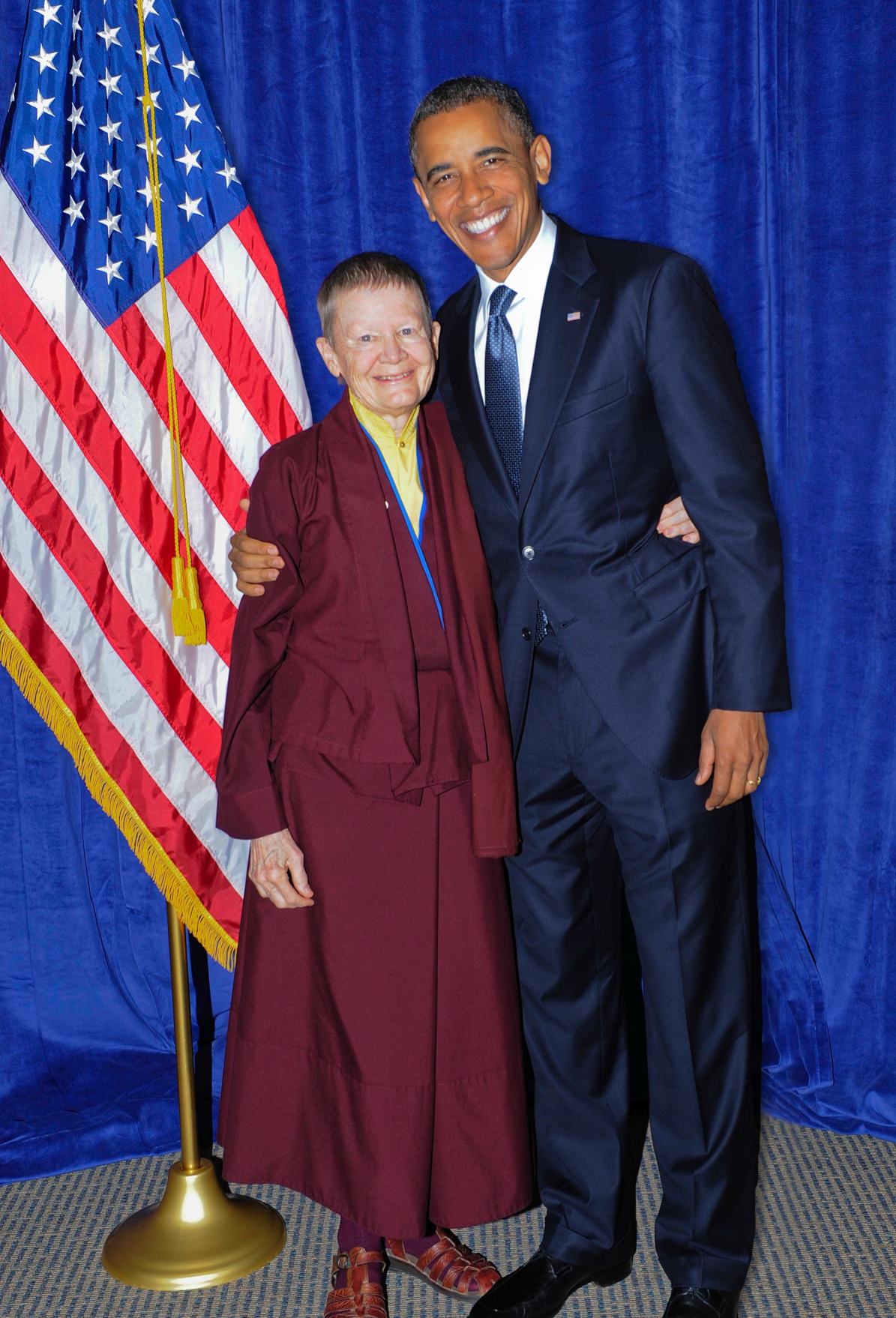
My meditation teacher, Pema Chödrön, is also a pretty big deal: a multi-million selling author and world-famous spiritual teacher (she is pictured here with someone you may have heard of. She doesn’t yet know that she’s my meditation teacher, but I’m hoping to meet her at a talk she’s giving in May and tell her!). Here she goes through her own slightly comical story of reduced circumstances.
Being Big and Small at the Same Time
I was once invited to teach with the Sakyong Mipham Rinpoche, my teacher’s eldest son, in a situation where it wasn’t exactly clear what my status was. Sometimes I was treated as a big deal who should come in through a special door and sit in a special seat. Then I’d think, “Okay, I’m a big deal.” I’d start running with that idea and come up with big-deal notions about how things should be. Then I’d get the message, “Oh, no, no, no. You should just sit on the floor and mix with everybody and be one of the crowd.” Okay. So now the message was that I should just be ordinary, not set myself up or be the teacher. But as soon as I was getting comfortable with being humble, I would be asked to do something special that only big deals did. This was a painful experience because I was always being insulted and humiliated by my own expectations. As soon as I was sure how it should be, so I could feel secure, I would get a message that it should be the other way. Finally I said to the Sakyong, “This is really hurting. I just don’t know who I’m supposed to be,” and he said, “Well, you have to learn to be big and small at the same time.”
I think the lessons to take from all three stories, Vince’s, Sandra’s, and Pema’s, are that you are sometimes big and sometimes small, that you have to juggle those roles, and that there’s something to be gained from doing it gracefully. I am sometimes quite big. As a bankruptcy trustee, I am the only officer of the court most debtors and creditors ever appear before. It can be a very powerful position. However, I often deal with judges with more authority than I have, and many, many lawyers who are more accomplished than I am. As I pointed out in my very first post, I am small potatoes in so many realms, including in my own family (at home, the kids know well that Mom is the boss)! I try to carry the lessons from these other roles into my work as a trustee and a lawyer and remember that many debtors have been bigger than me and have fallen because they tried reaching for the brass ring that was just out of reach. Even if they were rich or famous at some point, they are not so different from me. We are both small pieces of an infinitely vast creation.
I think the reason we struggle with this change of roles is that we become attached to being big – to deference, to certain surroundings, to mental and physical comfort. When we are not in our comfort zones, we suffer a little or a lot. Vince was a much better football player than he was a financial wizard. Sandra enjoys the limelight but worries about her child eating his lunch. Pema is a better speaker than audience member. In each case, the flipping of the roles brings a kind of suffering.
To bring it back to a circumstance we as people involved in the legal world can relate to, a few days ago I counseled a friend of mine, another lawyer, who was annoyed when a client questioned him. The client is elderly and asked my friend to speak to the client’s son about the issue. My friend became indignant and made the assumption that the client didn’t trust him or thought the son was smarter than he is. Those are not the words the client used – he may have just been confused about the issues presented – but my friend’s mind quickly went there, and he created his own suffering through his attachment to a certain status: the competent, benevolent lawyer. When both his competence and benevolence were questioned, he became angry because he was attached to that role. I asked him to hear the words the client actually used rather than creating suffering through his attachment to his assumptions about the words the client used. He will be gentler to the client and himself, which, I think, is the first rule.
In the end, I think this is another reason to have a meditation practice, to remove those assumptions about ourselves that can hinder our ability to be the bigger person.


 Spiritually Bankrupt
Leave a comment